

Fresh news on media and advertising in Canada
Provided by AGP
Spyglasses Launches First Metric to Score Media Placements for AI Visibility
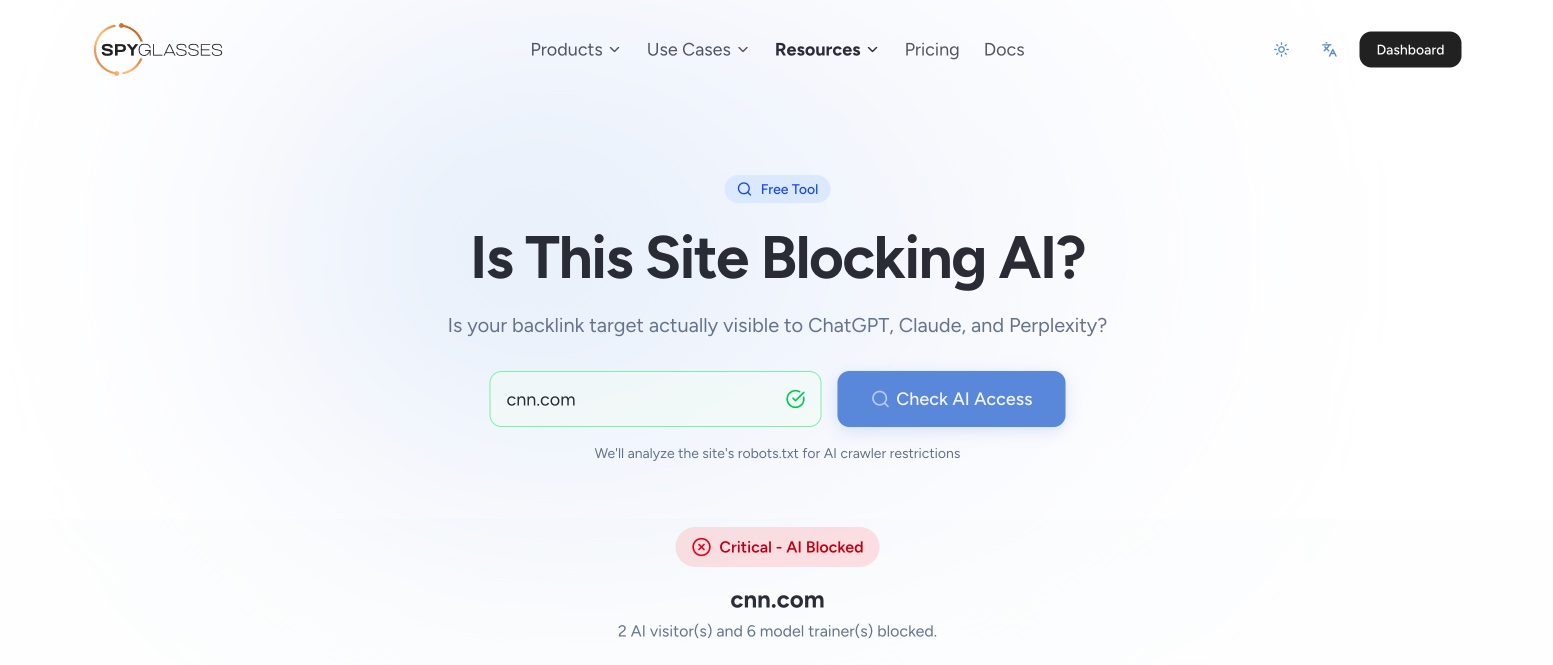
A screenshot of Spyglasses AI Access Checker showing the result for CNN

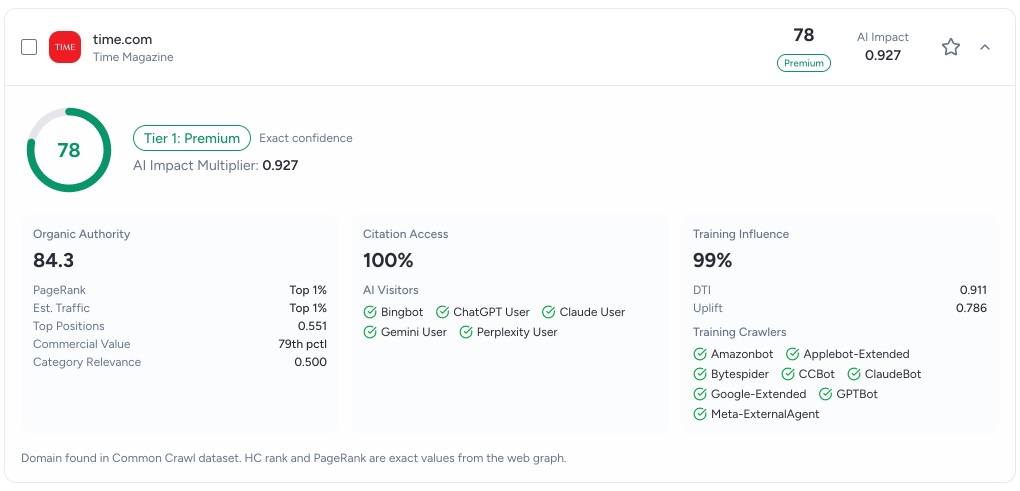
A screenshot of Spyglasses' AIVPS score for Time Magazine
Research shows earned media drives 85% of AI citations. The AI Placement Value Score measures which placements deliver AI visibility and which don't.
A strong PR strategy might target high-authority blocked sites for traditional credibility and AI-friendly sites for discoverability. The AIPVS helps make that evaluation with data, not guesswork.”
PITTSBURGH, PA, UNITED STATES, March 24, 2026 /EINPresswire.com/ -- Spyglasses today announced the general availability of the AI Placement Value Score (AIPVS), a new metric that combines a publication's organic authority with its AI accessibility to produce a single, comparable score for any domain. The score gives PR, communications, and link-building professionals a way to evaluate what a media placement or backlink is actually worth in AI-powered search and discovery.— James Wrubel CEO, Spyglasses
The launch comes as new research confirms that earned media is the dominant input shaping how AI represents brands. A study published by Muck Rack, a leading PR software platform, analyzed millions of AI-cited links across hundreds of thousands of prompts and found that more than 95% of citations in AI responses come from non-paid sources. Of those, 85% come from earned media. The study concluded that earned media materially influences what AI says about a brand, not just whether the brand appears.
For an industry built on securing high-value placements, this finding raises a practical question: how do you measure which placements deliver the most value in AI channels? The AI Placement Value Score is designed to answer it.
Key Takeaways
* AIPVS scores any domain from 0 to 100 based on organic authority, AI citation accessibility, and AI training influence, giving PR and link-building professionals a single number to evaluate placement targets.
* Muck Rack's research confirms the stakes. With 85% of AI citations coming from earned media, the value of a placement now depends on whether AI can actually access and cite it.
* 61% of the top 51 U.S. news sites block AI assistants from citing their content, according to a Spyglasses study. A placement on a blocked site may still carry traditional value but will not appear in AI-powered responses.
* AIPVS is available through the Spyglasses platform, API, Model Context Protocol (MCP) endpoint, and Claude Cowork skill, so teams can integrate scoring into existing media list workflows.
* A free tool, Is This Site Blocking AI?, is now available to check any website's AI policy and AIPVS instantly.
Why Placement Value Needs a New Metric
Placement value has traditionally been measured by domain authority, audience size, and SEO metrics. But AI assistants like ChatGPT, Gemini, Perplexity, and Claude now search the web and cite sources in real time. Whether a publication's content is accessible to AI has become a factor in what a placement is worth.
"Earned media has always been valuable. Muck Rack's research now confirms it's the primary input shaping AI responses," said James Wrubel, CEO of Spyglasses. "But not all placements are equal in AI channels. A feature on a site that blocks AI crawlers won't appear when someone asks ChatGPT for recommendations. The AI Placement Value Score quantifies that difference."
How the Score Works
The AIPVS evaluates three layers for any domain.
The first layer is the organic authority baseline. Spyglasses pulls domain-level metrics from DataForSEO, including domain authority rank, estimated traffic, ranking quality, commercial value, and traffic stability. These are the same types of signals used by established SEO platforms.
The second layer is AI citation accessibility. Spyglasses checks whether each major AI platform's browsing agent can access the domain's content, including crawlers for ChatGPT, Gemini, Perplexity, Claude, and Microsoft Copilot. Each platform's access status is weighted by its share of the AI market. The system checks both the published robots.txt policy and the site's actual infrastructure behavior to detect silent blocks.
The third layer is AI training influence. Using publicly available web graph data from Common Crawl, Spyglasses assesses how central a domain is in the link structure that AI companies use when building training datasets. This captures a longer-term form of visibility beyond real-time citation.
The three layers combine into a single 0 to 100 score mapped to four tiers: Premium (75-100), Strong (50-74), Moderate (25-49), and Limited (0-24).
Most Top News Sites Block AI. That Makes Policy Evaluation Essential.
A recent Spyglasses study of the top 51 U.S. news websites by monthly traffic found that 31 of those sites (61%) actively block one or more AI assistants from citing their content. These blocked sites account for 71% of total monthly traffic across all 51 sites, representing over 2.6 billion monthly visits. Only 11 sites (22%) have no AI restrictions at all.
"This doesn't mean a New York Times placement is less valuable," said Wrubel. "It means the value calculus has a new variable. A strong PR strategy might target high-authority blocked sites for traditional credibility and AI-friendly sites for discoverability. The AIPVS helps teams make that evaluation with data instead of guesswork."
The full study is available at https://spyglasses.io/blog/is-ai-blocking-your-best-media-placements.
Availability and Access
The AI Placement Value Score is available now to all Spyglasses customers through the platform's web interface, its REST API, a Model Context Protocol (MCP) endpoint, and a Claude Cowork skill. This means PR, communications, marketing, and link-building professionals can access scores wherever they already work.
Spyglasses is also making a free tool available at https://spyglasses.io/ai-access-checker that evaluates any website's AI access policy and displays its AIPVS. The tool checks a site's robots.txt against more than 600 known AI agents tracked by Spyglasses, requires no account, and is available immediately. Full methodology documentation is published at https://spyglasses.io/docs/methodology/ai-placement-value-score.
About Spyglasses
Spyglasses is the AI visibility platform for agencies and PR firms, helping teams prove the ROI of earned media outreach and AI optimization work. The platform combines prompt tracking, site auditing, AI traffic analytics, and earned media intelligence to bridge the gap between measurement and action. Spyglasses is the flagship product of Orchestra AI, Inc., based in Pittsburgh, PA. Learn more at spyglasses.io.
James Wrubel
Orchestra AI, Inc.
+1 412-206-1135
jim@orchestra-ai.com
Visit us on social media:
LinkedIn
YouTube
Legal Disclaimer:
EIN Presswire provides this news content "as is" without warranty of any kind. We do not accept any responsibility or liability for the accuracy, content, images, videos, licenses, completeness, legality, or reliability of the information contained in this article. If you have any complaints or copyright issues related to this article, kindly contact the author above.
